
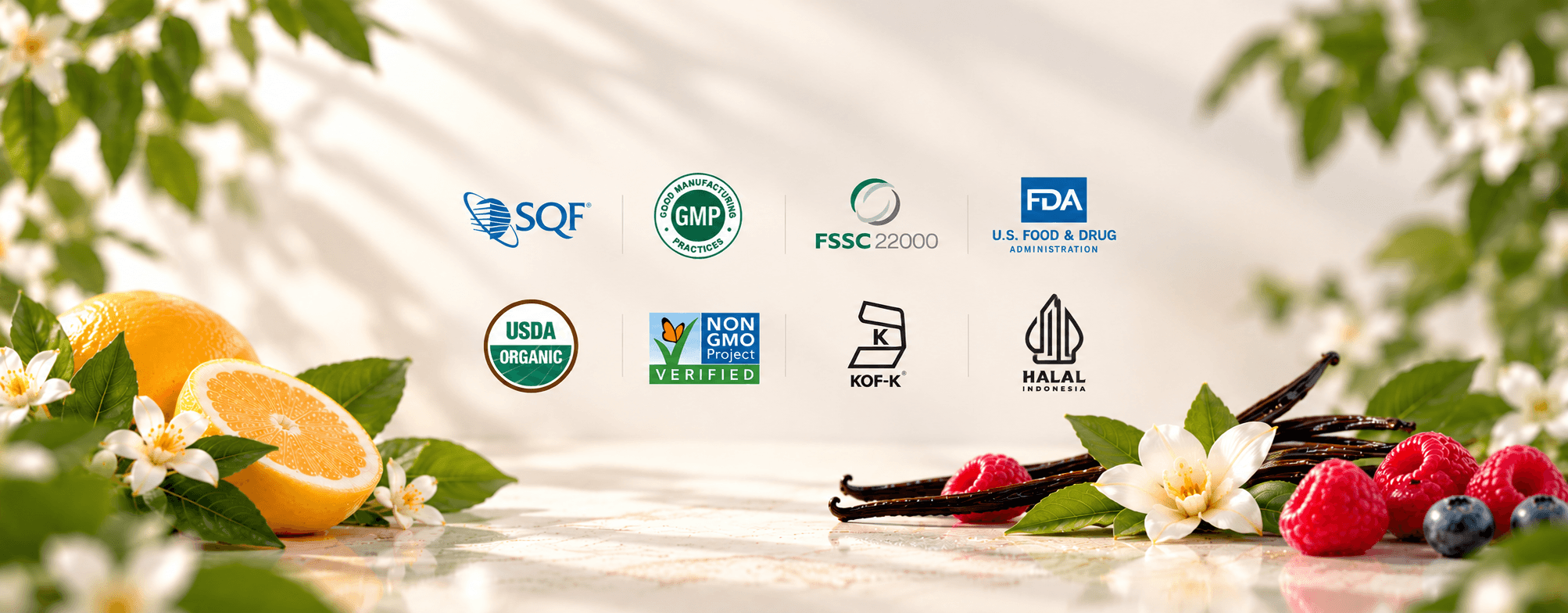
Certifications are among the most practical, and sometimes overlooked, criteria when qualifying a food flavoring manufacturer.
When a product launch depends on organic certification, Kosher or Halal status, non-GMO positioning, or a customer’s food-safety requirements, selecting a supplier whose capabilities don’t align with those requirements can create delays, documentation gaps, late-stage reformulation, or barriers to market entry. These are avoidable problems when certification requirements are defined before development begins.
This article explains the certifications and documentation food and beverage manufacturers should evaluate when selecting a flavor supplier, what each one means in practice, and how to build certification requirements into the development process from the start.
The right flavor supplier must match not only your sensory and technical requirements, but also your finished-product claims, customer requirements, and target markets.
Why Certifications Matter in Flavor Supplier Qualification
Flavor ingredients may represent a small percentage of a finished formulation by weight, but their certification status can affect the compliance and market positioning of the entire product.
Several dynamics are driving certification requirements earlier and deeper into the supply chain:
- Finished-product claims depend on individual ingredients: Organic, non-GMO, Kosher, and Halal status of a finished product can be affected by the certification status of its flavors. A flavor that doesn’t meet the required standard can disqualify an entire product from its target claim.
- Retailer and customer requirements are expanding: Retailers, co-packers, and foodservice operators increasingly require GFSI-recognized food-safety certification from all suppliers, including flavor manufacturers.
- International markets add regulatory complexity: Export markets carry specific certification requirements that differ from domestic standards. A supplier qualified for one market may not be qualified for another.
- Certification gaps discovered late are expensive: Discovering that a flavor doesn’t hold Kosher status after sensory approval, or that a supplier’s certification has lapsed, forces reformulation or launch delays that are entirely avoidable.
One distinction is essential before evaluating any supplier’s credentials: not all certifications apply in the same way. Some evaluate the manufacturing site’s food-safety management system. Others apply to specific ingredients, formulas, or product claims. Buyers need to assess both, separately.
Food Safety Certifications and GFSI-Recognized Schemes
Food-safety certifications confirm that a manufacturer’s facility, management systems, and production processes meet recognized international standards. SQF, FSSC 22000, and BRCGS are the three most widely recognized schemes globally. A supplier does not necessarily need all three, the appropriate certification depends on customer requirements, manufacturing location, and target markets.
SQF, Safe Quality Food
SQF is a GFSI-recognized certification program managed by the SQF Institute and widely used across North American food manufacturing and supply chains. It covers food-safety systems, hazard controls, traceability, verification, and documentation.
SQF is widely recognized across North American food manufacturing and retail supply chains and can help satisfy customer requirements for GFSI-recognized food-safety certification. For brands developing products primarily for the North American market, it is one of the food-safety credentials commonly encountered during supplier qualification.
FSSC 22000
FSSC 22000 is a globally recognized food-safety management system certification built around ISO 22000, incorporating sector-specific prerequisite programs and additional FSSC requirements. It is used across international food manufacturing supply chains and is recognized by GFSI.
FSSC 22000 is particularly relevant for manufacturers operating internationally or supplying customers that require GFSI-recognized food-safety certification. Its ISO-based structure also makes it well suited to organizations operating across multiple markets and supply chains.
BRCGS
BRCGS (Brand Reputation Compliance Global Standards) is a GFSI-recognized food-safety standard with a strong presence in international retail supply chains. It covers food safety, quality management, operational controls, traceability, and site standards, with a particular emphasis on product integrity and brand protection.
BRCGS can be particularly relevant for manufacturers supplying UK, European, and international retail or private-label supply chains where the standard is commonly requested as part of supplier qualification.
Ingredient and Label-Claim Certifications
Unlike facility food-safety certifications, ingredient and label-claim certifications apply to specific formulas. They must be evaluated and confirmed for each flavor being purchased, not assumed from a supplier’s facility-level credentials.
USDA Organic
Organic certification of a flavor must be evaluated at the specific formula level. A manufacturer capable of producing organic flavors does not mean every flavor in its portfolio is certified organic, each formula must meet USDA National Organic Program requirements independently, including ingredient sourcing, processing method, and documentation.
Since December 2019, USDA NOP rules require brands pursuing the USDA Organic seal to use certified organic flavors when commercially available. Confirming a flavor’s organic status early in development, before sensory approval, avoids reformulation risk later.
When qualifying an organic flavor, request the supplier’s current organic certificate, the confirmed organic status of the specific flavor, and any Natural Flavor Declaration documentation required by your certifier.
Kosher
Kosher certification requires more than ingredient verification. It involves review of manufacturing processes, equipment and production controls, cleaning procedures, and supply-chain documentation. Certification must be confirmed for the specific flavor or formula, not assumed from a facility-level credential.
Major US Kosher certifying organizations include the Orthodox Union (OU), KOF-K, Star-K, and the Chicago Rabbinical Council (cRc). Each maintains searchable databases of certified products; certification status can be independently verified.
Kosher certification carries commercial relevance beyond products specifically marketed to Jewish consumers. It may be required by retailers, foodservice customers, co-manufacturers, or brands that maintain Kosher certification across their ingredient supply chain.
Halal
Halal certification requirements vary by certifying body and destination market. Ingredients, processing aids, carriers, alcohol usage, manufacturing practices, and supply-chain controls can all affect Halal status. A supplier’s Halal certification must be evaluated against the specific requirements of the intended market.
Certification bodies and recognition frameworks differ by market, including Indonesia, Malaysia, and countries across the Gulf region. For brands targeting markets with formal Halal requirements, confirming that the supplier’s certifying body is recognized by the relevant national authority is as important as confirming the certification itself.
Non-GMO Project Verified
Non-GMO Project Verified is a third-party verification program that includes requirements for ingredient sourcing, traceability, segregation, and risk assessment. It is one of the most recognized consumer-facing claims in the North American natural food channel.
Non-GMO Project Verified and USDA Organic are separate programs with different requirements and labeling implications. A product can hold one without the other. Brands should determine which claim their finished product requires and verify the specific flavor accordingly.
Specialty Certifications and Allergen Documentation
Gluten-Free
Gluten-free certification at the ingredient level involves ingredient sourcing verification, cross-contact controls, and supplier documentation. When a finished product carries a third-party certified gluten-free claim, the certifying program may require supporting documentation from flavor suppliers. There is a meaningful difference between a supplier declaration of gluten-free status and a formula certified under a recognized gluten-free program; buyers should confirm which level of documentation their certifier or customer requires.
Vegan and Plant-Based
Certain flavors may require additional evaluation for animal-derived ingredients, carriers, and processing aids. Formal third-party vegan certification may be required when the finished product carries a certified vegan claim. As the plant-based category grows, this is increasingly relevant for flavor suppliers serving meat alternative and dairy alternative manufacturers.
Allergen Management Documentation
Allergen management is not a certification, but it is one of the most critical supplier qualification considerations for buyers in the snack, bakery, confectionery, and supplement categories. A flavor manufacturer should be able to provide documentation covering allergen presence, cross-contact controls, manufacturing procedures, ingredient specifications, and applicable allergen statements. For the US market, documentation should cover the FDA’s nine major food allergens; for European market access, the EU’s 14 declarable allergens apply.
Facility Certification vs. Formula Certification, The Critical Distinction
The most common misunderstanding in flavor supplier qualification is assuming that a supplier’s facility certifications apply to every flavor in their portfolio. They do not.
A flavor manufacturer’s facility may hold strong food-safety credentials, SQF, FSSC 22000, BRCGS, while a particular flavor does not meet the certification requirements of your finished product. The reverse is equally possible: a specific formula may be Kosher and organic certified, while the supplier’s facility food-safety credentials don’t meet your retailer’s qualification requirements.
Don’t ask only “Is your company certified?” Ask: “Is this specific flavor documented and certified for our product, claims, customers, and target markets?”
How to Align Certifications With Your Development Pipeline
Building certification requirements into the development process from the beginning, rather than discovering gaps after sensory approval, reduces reformulation risk, documentation delays, and supplier re-qualification costs.
1. Define Your Finished-Product Claims
Before shortlisting flavor suppliers, determine which certifications the finished product label requires: organic, non-GMO, Kosher, Halal, vegan, gluten-free, or other market-specific claims. Each claim has documentation implications that must be traced back through the ingredient supply chain.
2. Identify Customer and Market Requirements
Retailer, co-packer, and foodservice customer requirements may go beyond label claims. A retailer’s supplier qualification program may require GFSI-recognized food-safety certification regardless of what appears on the label. Export markets may require credentials not needed for domestic sales. Map these requirements before engaging suppliers.
3. Qualify the Facility and Verify the Specific Flavor
Confirm which food-safety certifications the supplier’s manufacturing site holds and whether they are current. Then confirm the certification and documentation status of each flavor being considered separately. Do not assume that facility-level credentials apply to every formula.
4. Request Current Documentation
Certifications expire and are subject to renewal audits. Request current certificates, not references to past results. Also request ingredient specifications, allergen documentation, and any formula-specific declarations required by your certifier or quality team.
5. Incorporate Requirements Into the Development Brief
Communicate certification requirements to the flavor supplier before development begins. A supplier who knows the target claims, markets, and customer requirements from the outset can flag potential issues early, before sensory approval creates commercial pressure to keep a non-compliant formula.
Flavor Supplier Certification Checklist
The following questions provide a practical framework for procurement and R&D teams evaluating a new flavor supplier or qualifying a specific flavor for a product under development.
| Can certification documentation be provided to our certifier or quality team? | Faster qualification and approval, experienced suppliers have documentation ready |
Frequently Asked Questions
- What certifications should a food flavoring manufacturer have?
There is no universal certification portfolio every flavor manufacturer must hold. Requirements depend on your organization’s supplier standards, customer requirements, finished-product claims, and target markets. Facility food-safety certifications and formula-level certifications address different compliance questions and should be evaluated separately. - What’s the difference between SQF and FSSC 22000?
Both are GFSI-recognized food-safety certification schemes, but they differ in structure and geographic prevalence. SQF is widely used in North American food supply chains, while FSSC 22000 is built around ISO 22000 and used globally. The appropriate certification depends on your customers, markets, and supplier qualification requirements. - Does a flavor supplier’s certification automatically transfer to my finished product?
No. A supplier’s facility certification demonstrates aspects of their manufacturing systems and processes. Ingredient-level certifications may apply to particular formulas but must be confirmed per flavor. Finished product certification is a separate process governed by the applicable standard and certifying organization. - How do I verify whether a flavor is Kosher or Halal certified?
Request current formula-specific documentation and verify the certification directly with the issuing organization. Major Kosher certifiers including OU, KOF-K, and Star-K maintain searchable online databases. For Halal, also confirm that the certifying body is recognized by the relevant national authority in your destination market. - Is USDA Organic the same as Non-GMO Project Verified?
No. They are separate programs with different standards, documentation requirements, and labeling implications. Confirm which claim your finished product requires and verify the flavor accordingly.
Conclusion
Certifications are not administrative paperwork, they are commercial access credentials that directly affect supplier qualification, product claims, customer acceptance, and market entry.
Selecting the right food flavoring manufacturer requires evaluating both the facility-level food-safety credentials and the certification status of the specific flavors being developed. These are separate questions that require separate documentation. Establishing requirements early, before development begins, reduces documentation gaps, avoids unnecessary reformulation, and streamlines the path from development to commercialization.
Evaluating a flavor for your next product? Contact OSF’s team to request a certification summary or confirm the certification and documentation available for your specific application.